About the author

A record-breaking Destinations International Annual Convention wrapped last month in Chicago (2,033 total attendees), and we hope you got a chance to see our own Todd Brook outline what you need to know about AI for the back half of 2025.
But we know it was a packed two days of sessions, talks, meetings, and (hopefully) enjoying our beautiful city of Chicago. Whether you missed the talk or need a quick recap of the highlights, here are some of the key points to take with you into your strategic plans for the rest of the year and beyond.
Understanding the AI landscape
“We are no longer at that point where we should be having the debate, ‘Is AI a tool that we should be using?’”
It probably feels like AI is everywhere right now, from your Zoom calls to your favorite brand’s websites (hello, chatbots).
Despite what might feel like widespread AI proliferation, barriers to adaptation remain: concerns about data security, negative impacts on the environment, and anxieties around job security. While these worries are valid, AI isn’t going anywhere, or even slowing down. And resistance can put you at a serious professional disadvantage.
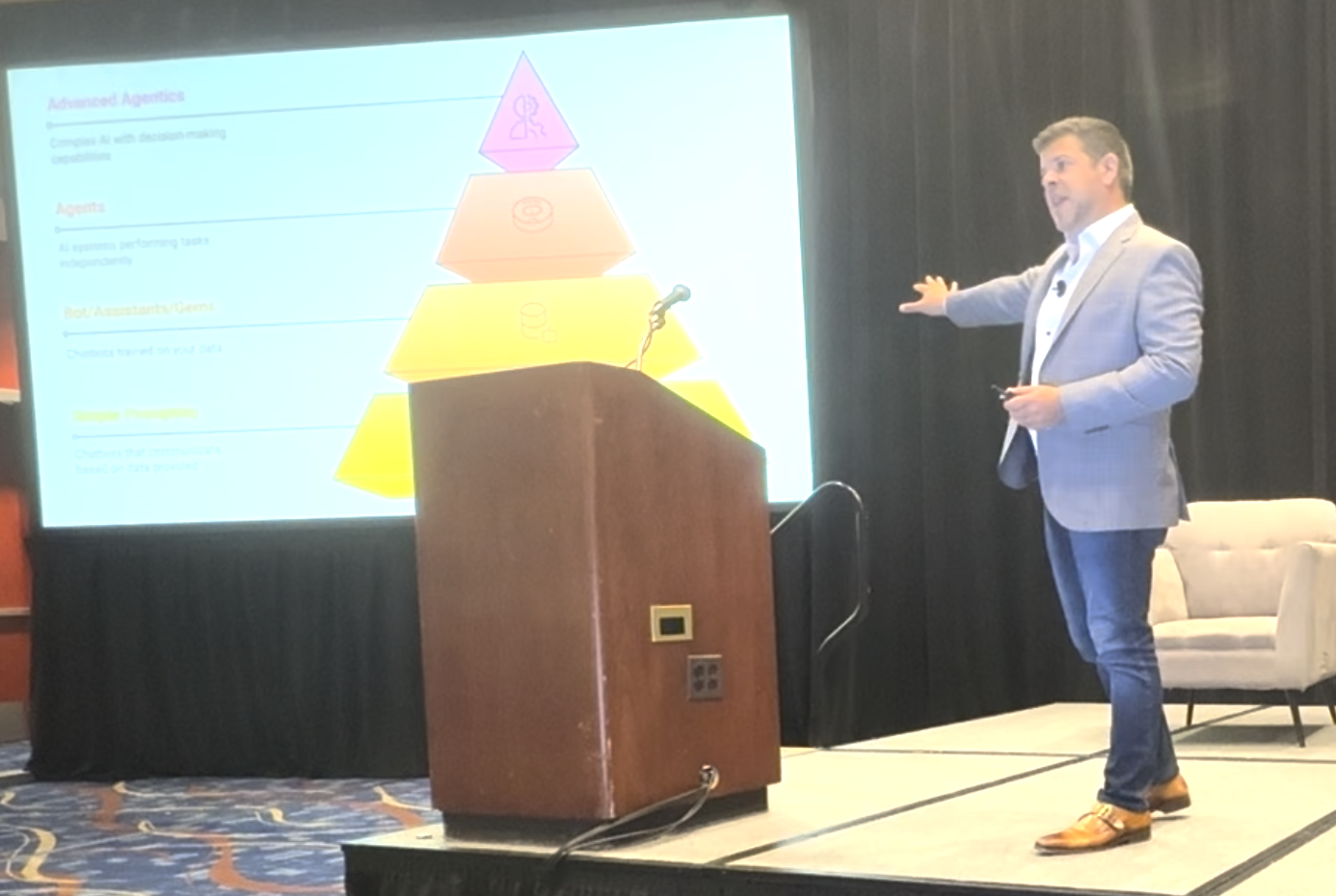
To fully understand where AI is and where it’s going, it’s important to know the four basic building blocks of today’s AI landscape:
- Simple prompting
- Bots/assistants
- Agents
- Advanced agentics
Back to basics: The elements of a good prompt
“When I need an analysis or I need to understand the performance of something, I can simply explain to this technology who it is, what it knows, and how to behave and utilizing any of the many products online, I’m able to very quickly get that answer.”
AI is moving fast and has gone way beyond the simple prompt-and-response model that most people are most familiar with.
Despite the leaps and bounds being made in the AI space, prompts are still a crucial tool for using AI efficiently and effectively.
So what does a good prompt look like? Here are a few of the key elements to include:
- A persona: who you want the AI to be (e.g., a marketing manager, a data analyst, etc.)
- An objective: the overall goal of your request
- Inputs: any data, documents, brand guidelines, and other resources that can help with your request
- Nuance: any necessary context for the inputs and data you provided
- Target output: the format you would like the response to be (a PDF, Excel doc, chart, narrative, etc.)
- Double-check: AI is much more accurate when you ask it to check its own work.
While this might feel like a lot of work, consider it a one-time investment. Make sure to save your work to reuse and refine down the road until you’ve cultivated a library of tried-and-true prompts.
Todd tip: A good prompt has at least 200 words. It might seem excessive, but the more specific you are with your prompts, the better responses you’ll get.
Be sure to check out our marketers’ guide to the teen years of GenAI for more on how to raise your AI into a responsible marketing partner.

Bring on the bots
“Training a bot is just like training a new hire. They may be useless on day one, but how quickly they become effective depends almost entirely on the onboarding.”
Bots and AI assistants are becoming ubiquitous. Almost every brand has its own version to chat with customers or help with internal efficiencies. These bots can interact with your company’s data and knowledge, creating huge opportunities for your organization.
When building out a bot, the first step is giving it instructions. You can think about this like onboarding a new employee. You need to explain its role, share background information, and clearly lay out what you want your new bot to accomplish.
The second half of the equation is knowledge: what information does it need? You can load in your brand guidelines, local and state laws, HR documentation, and beyond. This step is crucial, because you are giving your bot a pool of accurate information that it can use to generate outputs.
Todd tip: AI can be shockingly accurate when you limit what it can do. Spell out exactly where you want it to source information from to help eliminate inaccuracies and AI hallucinations.
The era of agents and agentics: What’s next for AI?
“We’ve got to be finding ways to simplify those repeated tasks.”
So what’s the latest when it comes to AI? Agents and advanced agentics are the talk of the town, and one of the most exciting and promising updates we’ve seen in AI technology. But you have to know how to harness it for your advantage.
- Agents: AI systems performing tasks independently
- Advanced agentics: Complex AI with decision-making capabilities
This technology builds on the existing foundations of prompts and bots. An agent can take the knowledge of a bot and use it to streamline tasks and complete tasks automatically.
The key difference is that agents pull together tool interaction, workflow automation, and your company’s data. That means it has the ability to unite information from different sources.
Imagine a tool that could take a recording of your meeting, create a transcript, save it to your files, and create a personalized to-do list. Or technology that could read your emails and create a summary of everything you did this week. That’s not the future… that’s AI agents.
The latest wave of agentics takes things even further. These systems can operate autonomously to solve problems, make decisions, and grow its capability over time, opening new doors to AI performance.
Long story short: if you’re not using this technology, you’re sacrificing time. Existing tools can help you easily build out interactive workflows that will streamline your daily tasks and offload daily labor time.
Todd tip: Try setting personal productivity goals around your AI usage. For instance, you can shoot for a set amount of time saved each week and check in on your progress at the end of the quarter.
Final thoughts
Today, we’re far beyond the point of debating the use of AI in the workplace; it’s like debating if we should be using the internet at the office.
The real conversation is about which AI tools your organization needs and how you can eliminate barriers to implementation.
It’s important to remember that you are ultimately accountable for your AI outputs. That means you need to double-check and confirm everything from the AI before you share and disseminate what you’ve created.
One hack for better accuracy? Ask the AI to check its own work. This will help weed out most of those pesky AI hallucinations (though you’re still on the hook for a final fact check).
At the end of the day, AI allows you to save time and create efficiencies that allow you to focus on higher-level tasks and functions and unlock a whole new way of working.
The second half of 2025 and beyond is full of opportunity. Ready to take your first (or next) steps toward greater efficiency through AI? Let’s talk.