About the author

TL;DR: The 2026 SEO forecast
- AI agents will complete tasks, search, compare, and transact on behalf of users.
- We’re entering the era of Search Everywhere Optimization as omnichannel search expands further beyond Google to social, video, forums, and AI platforms.
- Brand reputation becomes a core ranking and visibility signal.
- Entity clarity, content precision, freshness, and hyper-local optimization outweigh traditional keyword strategies.
- Branded search and high-intent visitorsbecome increasingly valuable even as overall traffic and clicks decline.
- Video, social media, visual search, digital PR, and proprietary data influence AI recommendations.
- Emerging channels like ChatGPT ads require careful monitoring and strategy.
- Human expertise, transparent authorship, and integrated strategies across PR, product, social, and technical channels define which brands thrive.
What 2026 means for SEO: Insights from organic search experts
If 2025 felt like a seismic shift in the world of search, 2026 is shaping up to be the year the dust settles into a new digital landscape entirely. The ground shifted beneath us as AI overviews expanded, ChatGPT integrated search, and consumers began searching across social platforms, forums, and AI assistants as naturally as they once turned to Google.
As we move beyond the initial panic that AI has caused, we face a new reality where the fundamental definition of “search” has evolved.
So what’s next? We asked our team of senior SEO managers—seasoned strategists who’ve navigated every major algorithm shift for more than a decade—to look ahead and identify what 2026 holds for search marketing. This blog covers their predictions and strategic insights designed to help you prepare for the year ahead.
Our organic search team is in the trenches, watching these shifts unfold in real time. Here is what we believe the future of organic search looks like in 2026. Let’s dig in!
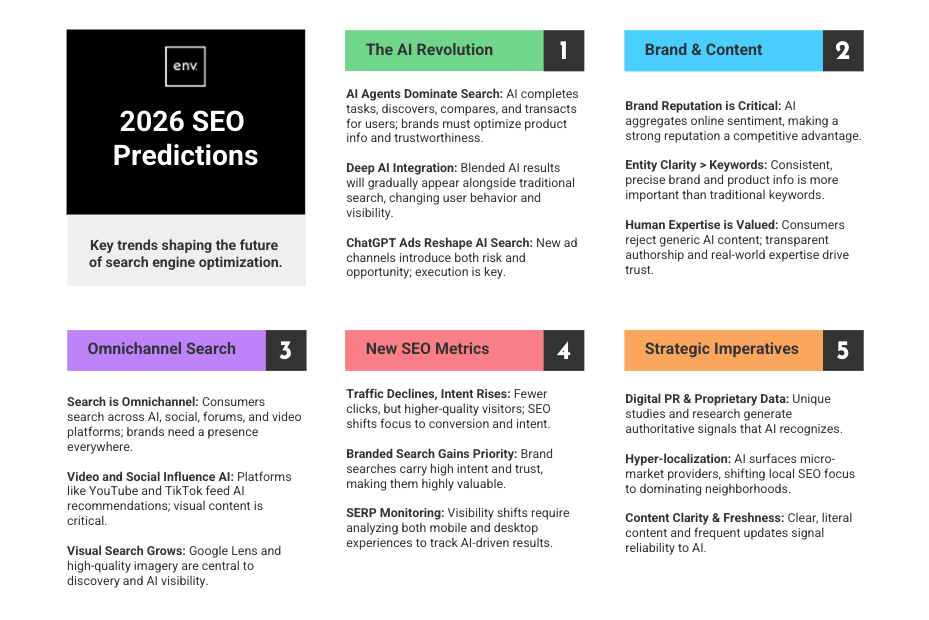
2026 SEO predictions
1.) AI agents and agentic search take center stage
Artificial intelligence is moving beyond just answering questions to completing entire tasks. AI agents will search, compare, and even transact on behalf of users, fundamentally changing how consumers discover and purchase products. Google is already testing agentic capabilities in AI mode, allowing users to go from discovery to purchase without leaving the AI interface.
For brands, this means optimizing not just for visibility, but for AI systems that act as purchasing intermediaries, making product information, pricing clarity, and trustworthiness more critical than ever.
2.) Brand reputation becomes a core ranking signal
AI systems are now aggregating everything the internet says about your brand—product reviews, customer complaints, social media chatter, forum discussions, and PR coverage—then using that composite to decide whether you’re worth recommending in their results. If your product has fundamental issues, AI will surface that sentiment. Poor sentiment becomes a visibility problem, while strong brand reputation builds a competitive advantage. The uncomfortable truth? SEO can’t “fix” fundamental product or service problems.
Success in 2026 means looking beyond content and technical tweaks. The brands that win will build a stronger product and value proposition, doubling down on real expertise and evolving based on authentic customer feedback. Product quality and brand reputation becomes the foundation—everything else is built on top of it.
3.) Search is happening everywhere, all at once
Search no longer starts or ends with Google. Consumers are searching on AI platforms, social media, YouTube, Instagram, forums, Reddit, and countless other spaces where information lives. AI assistants pull from this entire ecosystem, treating all public information as search data. For brands, SEO is evolving from traditional website optimization to managing a full organic presence across every platform where reputation, discovery, and authority signals exist. This new reality is Search Everywhere Optimization.
Search visibility is now truly omnichannel, and we expect the term ‘search everywhere optimization’ to become increasingly common in 2026. Brands that aren’t visible across the full ecosystem risk being overlooked by AI systems synthesizing information from multiple sources.
Learn how to optimize your social media for social search and AI Overview visibility.
4.) Frequent mobile and desktop search results (SERP) analysis become critical
Most new AI features, search modules, and interface experiments roll out on mobile first yet many marketers still review rankings and competitors exclusively on desktop. This creates a dangerous blind spot where major shifts in visibility, click-through rates, and feature placement go unnoticed for weeks or months. Meanwhile, AI traffic is increasingly skewing back toward desktop.
In 2026, monitoring both experiences becomes critical not for optimization tactics, but to actually see the real search environment your audiences experience across different contexts.
5.) Entity clarity outweighs keyword strategy
Search engines and large language models (LLMs) have shifted from keyword matching to entity understanding. Brands need crystal-clear information about who they are, what they offer, and why they’re credible—presented consistently across websites, profiles, and structured data. Ambiguity or inconsistent messaging leads to misclassification, directly harming visibility in AI-driven results.
This extends to company pages: About Us pages are increasingly influential in AI results, making content quality on these foundational pages absolutely critical in 2026. Entity optimization continues to overtake traditional keyword strategy in importance.
6.) Content clarity and freshness trump ambiguity
AI systems thrive on clear, literal language. Brands should favor straightforward descriptions over jargon, metaphors, and overly creative or branded messaging. The goal is minimizing AI (and user) misunderstandings. When an LLM can’t parse what you do or why it matters, you disappear from recommendations. This doesn’t mean dumbing down content; it means communicating with precision and structuring information so crawlers and users can scan, digest, and act on it quickly.
Additionally, content freshness matters more than ever. Brands need processes and resources to refresh content frequently, signaling to AI systems that information is current and reliable.
7.) Hyper-localized search reduces reach and increases competition
Local visibility will narrow as AI search gets better at surfacing extremely close-proximity providers. Businesses that once reached an entire metro area will find their radius shrinking to micro-markets. This hyper-localization increases direct competitors and elevates factors like real-time inventory, immediate local relevance, and recent customer reviews.
Local SEO in 2026 becomes less about broad category ranking and more about micro-market dominance. The goal is winning your specific neighborhood or district rather than an entire city.
8.) Brand search becomes more valuable that non-brand search
SEOs have historically prioritized high-volume non-brand queries, but 2026 flips this logic. Branded search carries intent, trust, and significantly higher conversion potential—exactly the signals AI systems favor. It’s easier and more profitable to influence people who already know your brand than to chase cold audiences with declining organic impressions.
Growing branded demand shifts from a marketing byproduct to a strategic SEO initiative, making brand building and awareness campaigns integral to your 2026 search strategy.
9.) Organic traffic continues to decline, but user intent quality rises
As AI consolidates answers directly in search results, fewer users will click through to websites, especially for informational queries. However, the users who do reach your site will be much farther along in their decision process. SEO thinking shifts from traffic volume to intent density.
Conversion optimization, product clarity, and experience design become integral to SEO success as the funnel compresses. The goal isn’t more visitors. The goal is attracting the right visitors, primed to convert.
Explore these resources on how to approach SEO reporting and measurement in 2026:
- A complete guide to AI metrics & KPIs
- How to shift stakeholder mindsets on evolving SEO metrics
- SEO metrics that matter: Ditch the outdated and track these instead
10.) Digital PR and proprietary data become essential
With AI systems pulling from the entire web to form opinions about brands, earned media coverage and unique data assets become powerful differentiators. Brands should invest in original studies, research, and proprietary information that can’t be replicated. Publishing unique insights generates citations, backlinks, and the kind of authoritative signals that LLMs recognize and prioritize when recommending solutions to users.
11.) Video and social media continue to heavily influence AI results
Visual platforms aren’t optional anymore—they’re core search channels. AI systems increasingly reference YouTube videos, Instagram content, TikTok posts, and other social media as authoritative sources when formulating recommendations. Brands without a strong video and social presence are missing from entire dimensions of AI-powered search.
This means your 2026 SEO strategy must encompass content creation and optimization across visual and social platforms.
12.) Google Lens and visual search rise to prominence
Modern consumers interact with the world through images and videos. Google Lens allows users to photograph products and receive instant search results. This capability will become increasingly central to brand discovery in 2026.
Brands must ensure they have high-quality, diverse images across their sites not just for aesthetics, but as searchable assets that feed visual search algorithms. Product imagery, environmental shots, and visual context become key success factors.
Explore how multimedia content influences both traditional SEO and AI search performance.
13.) Ads could reshape the AI search landscape
ChatGPT and other platforms plan to launch advertising within its platform in 2026 (maybe?), and execution will be everything. If ads feel intrusive or degrade the user experience, it could negatively impact ChatGPT’s market share, driving users toward alternative AI or traditional search platforms.
For marketers, this introduces both risk and opportunity: a new ad channel with uncertain user reception, requiring close monitoring of platform adoption and ad performance as the rollout unfolds.
14.) AI features integration in search accelerates
Google won’t flip a switch and replace traditional results overnight, but AI responses will continue weaving deeper into the search experience. Expect more blended answer boxes, follow-up prompts, summaries, comparison tools, and AI modules appearing before or beside traditional blue links. These rollouts will be gradual and inconsistent across queries and devices, making them easy to miss unless you’re actively monitoring real search results.
Over time, AI elements will claim more visual priority and shape user behavior long before any “full AI mode” becomes the default.
15.) Consumers will reject AI slop and seek real human expertise
Consumer sentiment toward AI-generated content is already negative, and as generic AI content floods the internet, that rejection will intensify. People will actively seek out content that offers a unique perspective or information that can only come from lived experience. This shift transforms Google’s E-E-A-T principles (Expertise, Experience, Authoritativeness, and Trustworthiness) from a behind-the-scenes ranking factor into actual consumer behavior.
Brands must prioritize content authorship by clearly identifying who created content, showcasing their credentials and experience, and being transparent about the human expertise behind the information. Anonymous or ambiguously authored content will lose trust and visibility, while content with clear attribution to qualified humans will stand out as the antidote to AI-generated noise.
Expert perspectives: Inside our SEO team’s 2026 outlook
We asked our SEO leaders at Envisionit what excites them most about the year ahead and their top advice for brands navigating this evolving landscape.
What excites you most about SEO in 2026?

“SEO feels fun again, even if the results are tougher to earn right now. The brands that tell the best, most meaningful stories are the ones rising to the top, not just the ones pumping out more articles.”
Erik Martin, SEO Manager

“What excites me the most about SEO in 2026 is the heightened importance now placed on SEO content thanks to AI visibility as a larger topic for businesses. It feels like SEO has long been an afterthought for businesses and brands alike, and now it is living at the forefront of almost every digital marketing conversation.”
Lawson Robinson, Senior SEO Manager
What is your biggest piece of advice for brands as they navigate the organic search landscape in 2026?
“Search in 2026 rewards brands that truly understand their audience. With so many new ways of showing up, SEO can’t be purely tactical anymore. The real wins come from listening to customers and creating quality content that reflects their needs, not just chasing traffic and keywords.”
Erik Martin, SEO Manager
“My biggest piece of advice for brands is to think less about how organic search can impact your site and more about how SEO can impact your entire brand. Search is happening everywhere all the time across search engines, AI platforms, and even social media. How can your brand reach the widest audience by appearing in all of these spaces?”
Lawson Robinson, Senior SEO Manager
The bottom line: The key to SEO success is integration
The common thread across all these predictions is integration.
SEO is no longer a siloed channel that lives in the backend of a website.
It is inextricably linked to your PR, your product quality, your social media presence, and your technical infrastructure. The brands that win in 2026 will be the ones that stop trying to “game” the algorithm and start feeding the entire digital ecosystem with genuine, authoritative, and reputation-backed value.
Are you ready to future-proof your SEO strategy?
The shifts happening in 2026 require a digital marketing agency that understands both the fundamentals and the future of search. The landscape is moving fast, but you don’t have to navigate it alone.
Get in touch with Envisionit to kick-start your 2026 SEO planning and ensure your brand remains visible in the age of AI.