About the author

If you’ve been wondering why your website isn’t getting the attention it used to, there’s a pretty simple answer.
Today’s search world wants more than words.
To stay visible and keep users engaged, your content needs multimedia. That means videos, images, graphics, and interactive elements that give your audience something to do, not just something to read. And this shift is changing how effective SEO, AI SEO, and GEO strategies are built. Let’s break down how and why that matters.
TL;DR: 4 key takeaways:
- Modern SEO, AI SEO, and GEO require multimedia content, not just text
- Videos, images, and infographics significantly boost engagement and time on site
- Higher engagement sends stronger ranking signals to search engines and AI platforms
- Using multiple formats increases your visibility across traditional, visual, and AI search

Multimedia drives user engagement metrics
Search engines don’t just look at keywords anymore. They look at how people act on your site. Are they staying or bouncing? Are they clicking and scrolling? Are they watching or interacting?
User attention is harder to earn than ever. Most people don’t want to scroll through long pages of text when they could watch a quick video or skim a graphic. That’s why websites with engaging content tend to see lower bounce rates. People actually stick around when the experience is interesting.
How multimedia content drives engagement
The stats speak for themselves. Users love video. In fact, people spend 2.6 times longer on pages that include video. Interactive elements (e.g., sliders, maps, quizzes, or galleries) keep users curious and active.
Pro tip: Interactive quizzes can serve multiple functions: 1.) They’re a fun way to boost onsite engagement, 2.) they are an effective method to pull visitors into the funnel for nurturing, and 3.) they can be used to capture unique industry data that fuels future content and touchpoints.
This extra engagement sends strong signals to search engines that say, “This content is helpful, and people like it.”
And that can boost your rankings.
Search is evolving beyond just text-based content
Google is always changing. Today’s search results are filled with featured snippets, image packs, and video carousels. Visual search is also growing, especially with tools like Google Lens that let users search for images instead of text.
In particular, visual search is becoming a major gateway for traveler discovery in destination marketing. Users can click on inspirational images and immediately explore the destinations behind them. Owning that visual real estate is going to be extremely important because, when someone taps a photo of your region, you want them landing on your site and not someone else’s.
If your content is only text, you’re missing huge visibility opportunities.
Why AI platforms love multimedia content
AI-driven search (e.g., Google’s AI Overviews, Perplexity, ChatGPT, etc.) loves mixing text with visuals. This is especially important for DMOs, where travelers want to see a place before they visit it.
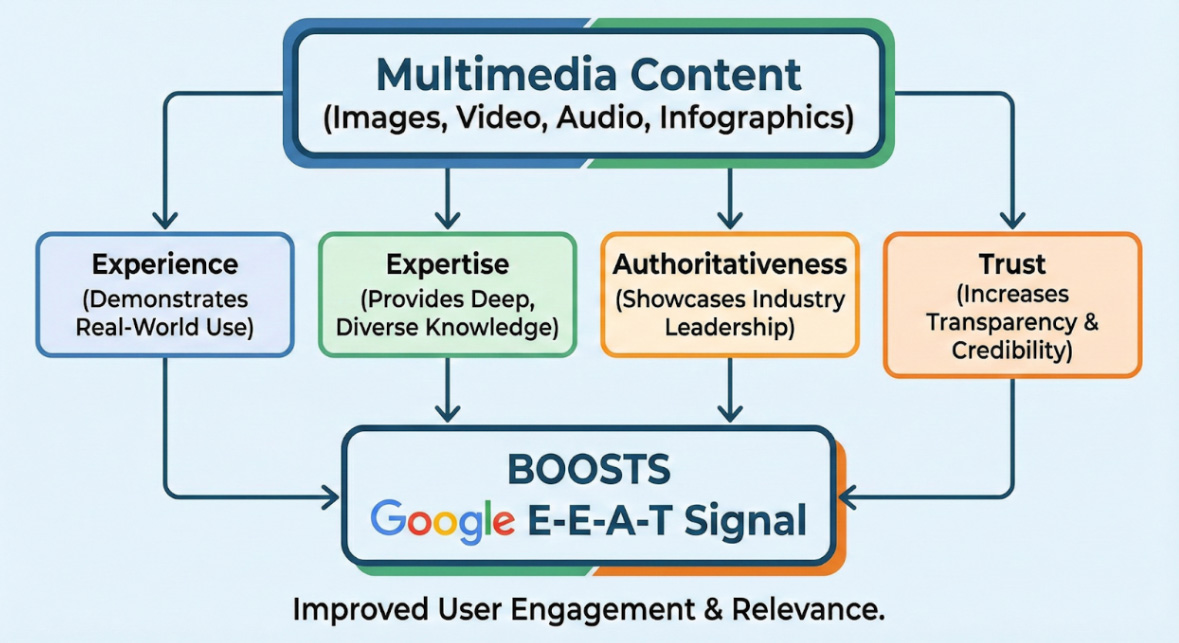
Multimedia also boosts your E-E-A-T signals (Experience, Expertise, Authoritativeness, Trust). A helpful video or graphic gives proof that you know what you’re talking about.
How to diversify your search presence across platforms
- Video SEO: YouTube is one of the most powerful platforms in AI search. Many AI tools actually pull from YouTube before pulling from websites (this is especially true for informational queries and ‘how to’ searches)
- Image SEO: Images show up in search more often than ever, helping your content stand out.
- Infographics: AI platforms often surface infographics before text because they make complex info easier to understand.
The more formats you use, the more chances you have to show up across search.
How to strategically implement multimedia assets
Adding multimedia to your content involves making smart, intentional choices that support your SEO, AI SEO, and GEO goals. The right assets can improve rankings, increase engagement, and make your content more useful for both humans and AI engines.
Here’s how to approach it with purpose:
Audit your current content for gaps and opportunities: Take a look at your website. Which pages are only text? Which pages could be stronger with a visual guide, a short video, or an infographic?
Pro tip: You can repurpose blogs and previously created content into infographics and visuals to help maximize the value of your brand’s creative/content output.
Find what format works best for your users: Every audience is different. Some love video. Some prefer quick-hit visuals. Some need interactive tools. Test and learn.
Can you do it in-house or do you need help? Great multimedia doesn’t need to be expensive, but it does need to be planned. Decide what you can produce internally and where you might need creative or technical support.
Repurpose content into infographics and videos: This is one of the easiest wins. Take a popular blog post and turn it into a short video. Turn key stats into an infographic. You don’t have to start from scratch; you can reuse what’s already working.
Example: When we released our latest article covering the SEO questions that every marketing leader should be asking, we also dropped this quick video outline:
Search engines, AI platforms, and users all expect richer, more engaging experiences. By investing in multimedia content as part of your SEO, AI SEO, and GEO strategy, you position your brand to stand out, earn trust, and stay visible as search continues to evolve.
Ready to make your content more visual, interactive, and dynamic? Let’s talk.