About the author

And what they reveal about the future of travel demand
I recently returned from the Travel and Tourism Research Association’s Marketing Outlook Forum in Charlotte, where the theme was “In the Driver’s Seat: Gaining the Competitive Edge in Marketing with Research and Data.” I couldn’t help but laugh a little, since many of our industry norms seem to have taken a hard left.
Over three days, I connected with economists, research leaders, and travel behavior analysts, exploring where tourism is headed. And while there was no single prediction that defined the conversation, the mosaic view revealed a clear picture of where travel stands today, and where it is likely heading next.
My biggest takeaway is that travel demand is not weakening, but dividing.
Overall interest in travel remains strong, but how travelers plan, prioritize, and spend is becoming more complex. That shift is creating both new opportunities and new risks for destination marketers. Tourism Economics President Adam Sachs used levity in his approach to this serious subject. As he put it, “our entire presentation is brought to you by the letter K,” which got a pretty good laugh from me and the gathered crowd.
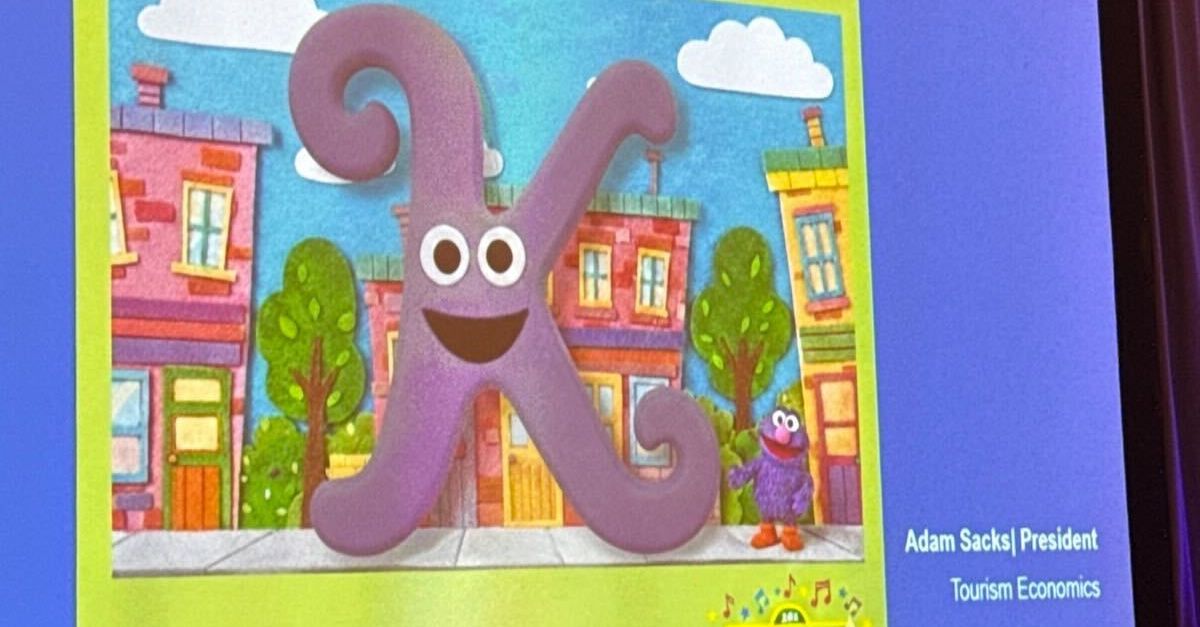
Ah, yes. The K-shaped economy. That’s when different groups recover from economic disruption at very different speeds. And it means some travelers are gaining spending power and confidence while others continue facing financial pressure and tougher travel decisions.
1.) The economy is dividing travelers into distinct spending groups
Something I heard again and again was the continued impact of a divided economic recovery.
Higher-income households continue to prioritize travel and absorb rising costs. At the same time, middle- and lower-income households are still managing rising everyday expenses, leaving less flexibility for discretionary spending.
Generational differences are also shaping travel behavior. Younger travelers are navigating uncertain job markets and high housing costs, while older travelers are often managing fixed incomes and healthcare expenses.
For destination marketers, this means the idea of the “average traveler” is becoming less useful. Today’s travel audience is made up of multiple groups moving at different financial speeds. Marketing strategies built around one universal visitor profile risk missing important truths and opportunities.
2.) Travelers still want to travel, but they are planning more carefully
The data shared during the event reinforced that the desire to travel remains very strong. What’s changed is how comfortable people feel committing to trips.
Travelers today are taking fewer trips, opting for shorter stays, and waiting longer to finalize their plans. They’re spending more time comparing options and carefully weighing financial tradeoffs. And they’re showing less patience for unexpected costs or complicated planning experiences.
People are not skipping out on travel. They’re just becoming a lot more deliberate.
Future Partners President and CEO Erin Francis Cummings summed it up nicely by saying, “Travel is no longer about the where. It’s about the why.” And that “why” is being filtered through travelers’ economic unease and a heightened need for reassurance.
And this shift creates a meaningful opportunity for destination marketers. Inspiration still plays an important role, but reassurance is becoming equally valuable. Visitors want confidence that their time, money, and emotional investment will be worthwhile.
Destinations are uniquely positioned to provide that reassurance through clear, honest, and helpful planning resources, and a discovery-friendly website with up-to-date content.
3.) Trust is becoming one of the most powerful marketing tools
So, travelers are not struggling to find inspiration. They are struggling with uncertainty.
Potential visitors can get frustrated by fluctuating prices, unclear policies, hidden fees, and the sheer volume of travel choices. Planning can feel risky, especially during uncertain economic times.
Destinations don’t necessarily need to replace booking platforms or travel agencies. But, they can play an important leadership role in building traveler confidence. Providing transparent information, realistic expectations, and curated recommendations can significantly reduce planning anxiety.
FACT: When visitors trust what they see, they are far more likely to convert that interest into an actual trip.
4.) Value is more important than price
This was repeated like a mantra at this event. Go ahead and say it out loud to yourself a few times. Seriously. I’ll wait.
In a rough economy, lowering prices can feel like the safest response. However, discounting often creates short-term demand at the expense of long-term brand strength. Once a destination becomes associated with lower pricing, it can be extremely difficult to rebuild perceived value.
This point was emphasized by Amir Eylon, President and CEO of Longwoods International, who said, “Resist discounting as much as you can.”
Travelers who have the financial ability to travel are still going to travel. But they are going to be making more intentional decisions. They want to understand what makes a destination worth the investment.
For destination marketers, this means shifting focus toward highlighting the full experience rather than competing on price alone. Showcasing included activities, unique local offerings, and emotional benefits such as relaxation or connection can strengthen perceived value without weakening brand positioning.
5.) Emotional motivations are shifting toward connection and restoration
Speaking of relaxation, another notable trend is a growing desire for travel experiences centered around emotional well-being.
After several years focused on individual bucket-list experiences, travelers are shifting toward trips that help people reconnect with loved ones, recharge from daily stress, and restore balance in their lives.
Travel is increasingly viewed as relief from responsibility. A sanctuary from stress. Which reveals a powerful storytelling opportunity for destinations. Messaging that highlights shared experiences, personal renewal, and meaningful connections is resonating strongly with travelers today.
But authenticity is essential. Emotional messaging must be supported by experiences that truly deliver on those promises.
6.) Regional travel and group trips remain reliable drivers
Domestic road travel continues to play a major role in visitation patterns. Regional travel provides low-risk planning flexibility and feels like the affordable option for many travelers.
The modern shift is how people are using trips to visit friends and family. Groups are choosing to meet in shared destinations rather than visiting individual hometowns. And these trips often include multi-generational travelers and focus heavily on shared activities.
This was one of the most interesting takeaways for me during the conference. Earlier in my DMO career, visiting friends and relatives (VFR) was often viewed in a bad light because it typically meant visitors stayed in private homes instead of local lodging, which limited economic impact. Today, that definition is clearly changing. Families and friend groups are meeting in destinations where none of them live, booking hotels, attractions, and group experiences together. That creates meaningful opportunities for the entire visitor economy.
Destinations that succeed in attracting these visitors are investing in planning tools that make group travel easier. Clear itineraries, family-friendly experiences, and easy-to-navigate visitor resources can significantly improve the planning process.
Don’t make the mistake of viewing regional travel as a secondary strategy. It remains one of the most stable and dependable visitation drivers.
7.) Booking patterns might be changing
New spending data suggests travelers may be relying more heavily on online booking marketplaces when finalizing travel purchases.
Arrivalist’s Jacob Pewitt-Yancy shared near real-time credit card spending analysis from roughly 60 million domestic cards through January 2026, indicating that booking behavior may be shifting toward online travel agencies. While it is too early to confirm a permanent change, it is a trend destinations should be watching closely.
If travelers are consolidating their bookings through comparison platforms and online travel agencies (OTAs), destination marketers may need to reevaluate partnership strategies and conversion campaigns.
Pro Tip: Understanding where and how visitors complete their purchases will become increasingly important when measuring marketing effectiveness.
8.) Retail spending is showing signs of growth
I was surprised to see visitor spending data that showed growth in shopping-related travel expenses. For years, travel marketing has emphasized the shift from purchasing goods to prioritizing experiences. While experiential travel remains important, this new data suggests travelers may again be placing value on tangible purchases.
During uncertain times, physical purchases can feel lasting and reassuring. This trend creates an opportunity for destinations to more intentionally highlight local retailers, artisans, and cultural marketplaces as part of the visitor experience.
My personal pocketbook can attest to this trend. I’ve spent more on retail purchases in the last six month than I have in probably the last two years.
Supporting local businesses has always been a core responsibility for destination organizations. This trend reinforces the importance of including retail experiences in destination storytelling.
9.) Avoid building strategies around only one traveler segment
While higher-income travelers continue to demonstrate strong travel activity, focusing exclusively on this audience carries risks.
Arrivalist’s Jacob Pewitt-Yancy agreed that the K-shaped market makes it tempting to over-index on affluent travelers (and there are good reasons to pay attention to them), but there are only so many high-spending travelers available. And destinations are all competing for the same group.
Destination organizations support entire local tourism economies. Hotels, attractions, restaurants, retail businesses, and community stakeholders all rely on a diverse visitor base. A strategy that only works for the top end leaves too many partners exposed. Successful marketing strategies in 2026 will require balanced audience planning.
And situations will change. Maintaining accessibility helps cultivate future loyal visitors. Travelers who discover destinations early in their lives could return as higher-spending visitors later.
Pro Tip: 2026 calls for portfolio thinking, not single-segment optimization.
In the driver’s seat: The road forward for destination marketers
For me, the TTRA Marketing Outlook Forum 2026 provided a great deal of clarity.
Travel demand remains strong, which is encouraging for the entire industry. At the same time, traveler behavior is becoming more fragmented, expectations are rising, and planning patterns are evolving.
The destinations that succeed in the coming year will not simply increase marketing volume. They will focus on being more thoughtful, more precise, and more empathetic in how they engage travelers.
Our collective route forward needs clarity. Clarity about who your visitors are, what they truly value, and how your destination can confidently meet those needs. When destinations lead with clarity, they reduce friction for travelers, strengthen trust with partners, and build strategies that are sustainable, not reactive.