About the author

For years, DMOs have marketed a product they don’t actually control. A living, breathing, deeply human product that evolves with the seasons and shifts year to year.
Yet, the technology that supports most DMOs has been the opposite. Rigid, standardized, and anything but flexible.
For more than a decade, the “safe choice” has been proprietary, all-in-one platforms. Hundreds of DMOs implemented them on the promise that they’d simplify everything from CRM to CMS under one roof.
And for a time, they worked.
But the digital landscape has changed dramatically over the last few years. Traveler behavior is shifting faster than ever, and AI is transforming how people research and plan trips. It’s a complete rewrite of how destinations get discovered.
In this new environment, DMOs need three things more than ever:
- Agility to adapt to changing technology
- Authenticity to stand out from the noise
- Control of their data to stay visible in AI-powered search
Unfortunately, closed-source systems aren’t helping. In fact, they’re standing right in the way.
Seeing the cracks in the ‘all-in-one’ foundation
On paper, legacy proprietary platforms promise seamless integration. But in practice, many DMOs are left throwing money at outdated tech with significant creative limitations.
How many of the challenges in the left column are you experiencing, and how often have you and your team wished for the solutions in the right column?
Challenges with proprietary systems | Benefits of moving to open-source |
|---|---|
| ❌ Outdated interface and performance issues: DMOs describe these systems as “old” and “clunky,” with frequent outages. | 👍 Scalable, stable hosting. Faster, more intuitive, and built to evolve. |
| ❌ Difficult and unclean reporting: Pulling clean, actionable reports can feel impossible. | 👍 Aligns to your KPIs, delivering clean, role-specific insights for marketing, sales, and leadership. |
| ❌ Steep learning curve and lack of training resources: Support is often dependent on third parties or outdated docs. | 👍 Integrated agency onboarding provides tailored training, custom video guides, and ongoing support. |
| ❌ Limited customization and high costs: Per-feature pricing quickly inflates budgets. | 👍 Unlimited flexibility with no per-widget fees or hidden costs. |
| ❌ Inability to handle specific business functions: Managing events, payments, or RSVPs requires extra integrations. | 👍 Can include these tools natively, designed around your workflows. |
| ❌ Under-leveraged and inconsistent data: Closed systems scatter data across silos. | 👍 Centralized and automated data, creating clean, actionable insights across channels. |
| ❌ Content and image restrictions: Arbitrary limits constrain creativity. | 👍 Rich storytelling, dynamic visuals, and flexible layouts. |
| ❌ Missing features and integration difficulties: Legacy all-in-one systems resist modern tool integrations. | 👍 Can integrate seamlessly with Canva, Adobe, DAMs, CMSs, and other automation tools. |
| ❌ Lack of pricing transparency: Hidden fees and auto-renewing contracts drain budgets. | 👍 Transparent pricing and open licensing with no surprises. |
| ❌ Perceived lack of flexibility and scalability: The “safe” choice often becomes the least flexible. | 👍 Built to scale and adapt as your destination grows. |
| ❌ Customer support concerns: Slow ticket queues become the norm. | 👍 Agency partnerships provide hands-on, relationship-driven support with proactive improvements and fast response times. |
How AI made your CMS an MVP
AI has changed how travelers get inspired and find information about their next destination.
According to a recent McKinsey study, 50 percent of consumers already use AI-powered search, and AI-powered search is already the most preferred source of information among users (44 percent). And they’re asking more specific questions to AI-powered assistants like “Find me a local art tour in Kansas City this weekend.”
Open-source CMS platforms structure your content in formats that both humans and machines can understand. They integrate seamlessly with AI and search engines, keeping your destination visible in the new traveler journey, even when AI is telling your story.
Check out this list of questions that tourism and destination marketing leaders should be asking their SEO teams about AI search visibility.
Gaining clarity and taking control of your digital future
It’s difficult to stand out when you’re relying on safe industry-standards. But, forward-thinking DMOs are proving there’s another way.
You don’t have to rip and replace your entire system overnight. You can ‘consciously uncouple’ strategically. Read these stories for a little inspiration in taking your first step toward digital freedom:
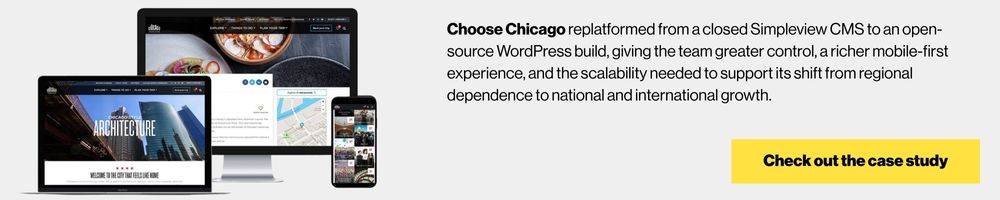

So, you can keep your CRM data and internal workflows if they’re working for you. But free your brand, your content, and your user experience with an open-source website and agency partnership designed for flexibility, not lock-in.
AI has changed so much of the digital marketing playing field. It’s possible that “staying safe” with an old guard industry standard website could be your biggest risk in visibility.
Ready to take back control of your website? Let’s talk.