About the author

TL;DR: Google I/O 2026 confirmed what the data already showed: organic search is decoupling from the website. Discovery, qualification, and even the purchase are moving to surfaces you influence but don’t own. To stay visible and prove value, brands must:
- Change the scoreboard: Grade organic on conversions and brand demand, not raw traffic. Traffic is and has been a micro metric for a while.
- Build for agents, not just people: Clean, fast, accessible HTML is your agent-readiness work. Stick to the fundamentals every AI engine agrees on, and test engine-specific tactics per platform rather than trusting any one engine’s rules.
- Optimize for search everywhere: Treat YouTube, social, and SEO as one discovery system feeding both people and the AI layer on every platform.
- Invest in credibility and proprietary data: Human expertise and your own first-party data are the content AI can’t replicate.
- Track brand search: High-intent, qualified, and increasingly the clearest signal as non-branded gets harder to see and measure.
For years, the industry described the job the same easy way. Rank, earn the click, win the session, report the traffic. The website was where search sent people, and the traffic line was how most teams proved the work was paying off. The smart ones always looked past traffic to what it actually converted, but traffic stayed the headline number almost everywhere.
After Google I/O 2026, that description is out of date.
The through-line across everything Google shipped this spring is that organic search is decoupling from the website. Discovery already moved off your site, into AI answers people read without clicking. Now qualification and even the transaction are moving off your website too, into agents that compare, book, and buy on a user’s behalf. Your site isn’t the front door anymore. It’s one room people and their agents reach after several decisions have already happened somewhere you don’t control.
That single shift reorganizes the work: where the budget goes, what you measure, and what “good” looks like in a review.
Here’s what I/O 2026 actually changed, what our team flagged in our Q2 working session, and what to do about it. (If you want our fuller forecast for the year, our 2026 SEO predictions lay out the longer view this builds on.)
What Google actually shipped at I/O 2026
Most of the I/O coverage was noise for marketers (XR glasses, video models, quantum). The slice that matters here:
- AI Mode crossed a billion monthly users. Queries are more than doubling each quarter, and it now runs on Gemini 3.5 Flash by default. The AI answer is the mainstream search experience now, not a side feature.
- Search got its biggest interface change in 25 years. A rebuilt, multimodal search box takes text, images, files, video, and Chrome tabs, and it’s built to anticipate intent. Queries get longer and more conversational, which changes how you brief content.
- Search agents arrived. Information agents run in the background 24/7 and report back, launching this summer for paid tiers in the US.
- Agentic commerce expanded. Agentic booking and calling for local services, plus agentic shopping and a Universal Cart that checks out across merchants.
- YouTube launched Ask YouTube. A conversational search that answers a complex question with a structured set of videos pulled from across the catalog. The second-biggest search engine is going conversational too.
- SynthID and Content Credentials are expanding across Search and Chrome. AI-generated content now gets labeled at the provenance level.
Hold two of those together. Agents that transact, and infrastructure that labels what’s machine-made. They point in opposite directions, and both matter below.
Discovery has already left your website
Start with the trend the team called the new baseline: zero-click searches.
It isn’t a forecast anymore. SparkToro’s 2026 analysis found that 68.01% of Google searches now end without a click to the open web, up from around 45% a decade ago. Worth saying plainly, because the scary headlines skip it: this isn’t search shrinking. Search volume is still growing, Google’s especially, so there are more searches than ever. A bigger share of them just resolve on the results page now, inside an AI answer, before anyone reaches a site.
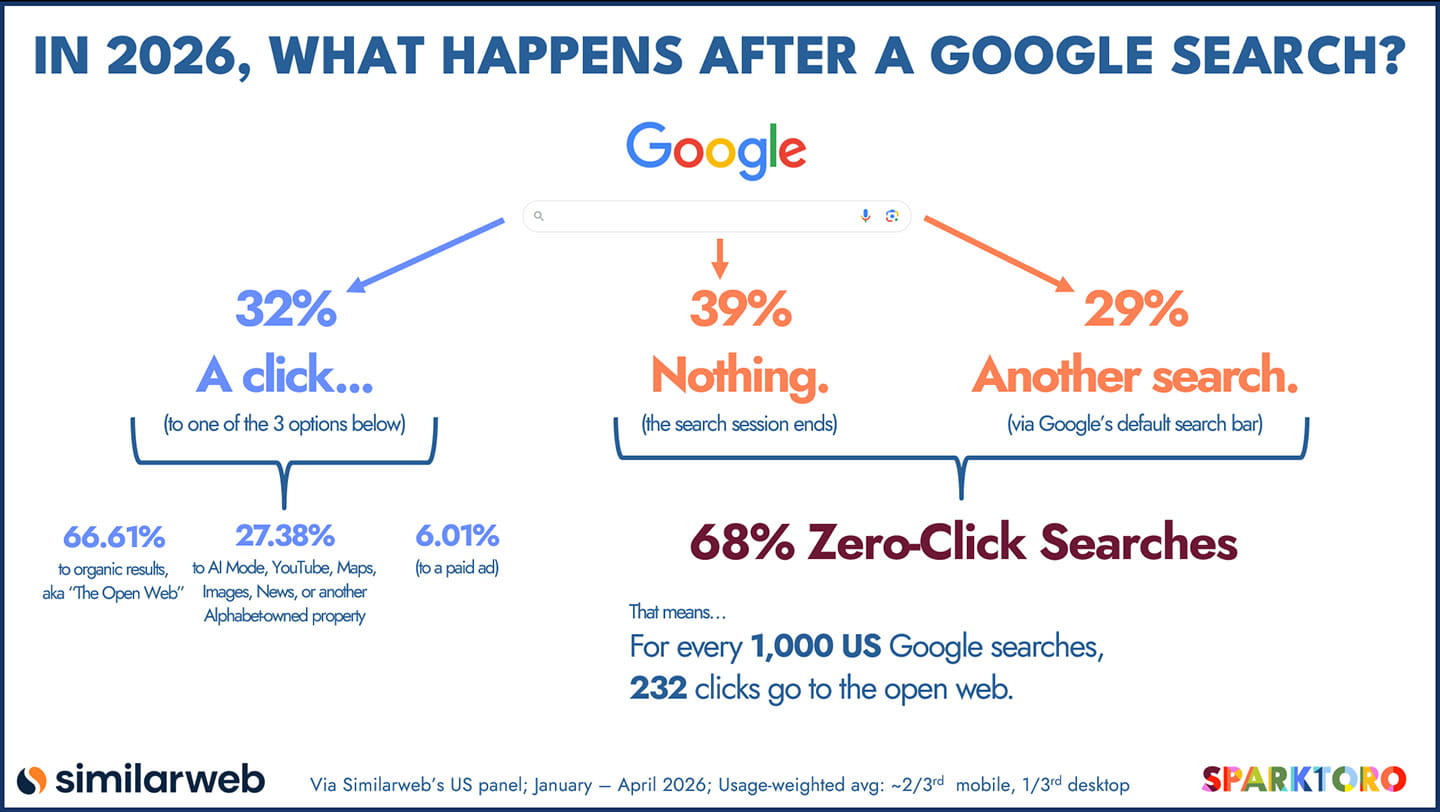
Here’s the part that should reframe how you think about SEO. This isn’t chatbots stealing your traffic, at least not directly. AI tools still send out less than 1% of all traffic to the open web. The zero-click shift is overwhelmingly Google answering questions directly to keep users inside its own results, and since more instant answers mean more return searches and more ad revenue, Google has every reason to keep going.
But don’t read “less than 1%” as “AI doesn’t matter.” Adoption is climbing fast, more than 20% of Americans now use an AI tool ten or more times a month, and that surge is exactly why Google is racing to put AI at the center of search. It’s afraid of being left behind. So the real pressure on your traffic isn’t chatbots siphoning clicks today, it’s Google reshaping its own results to keep pace with them. Plan for this to continue, not reverse.
The clickthrough data tracks the trend: Ahrefs, studying 300,000 keywords, found that the presence of an AI Overview cuts clickthrough on the top organic result by 58%. So the surface isn’t shrinking. The clickthrough rate on it is.
This is where our team’s long-standing position stops sounding contrarian and starts sounding obvious. Traffic is a micro metric. Conversions are the macro one. We’ve always graded SEO on conversions and conversion rate rather than raw sessions, and the zero-click era makes that the only sane scoreboard. The people who still click are the ones the AI answer couldn’t satisfy, so they arrive later in the decision and are ready to act.
Be honest about the evidence there: “more qualified” is partly inference, and some of it is measurement noise from bot traffic. It’s also genuinely hard to prove right now, since the tooling to cleanly separate and value those visitors isn’t there yet, so treat it as a working assumption to pressure-test against conversions, not a number for a deck. The leadership move is to stop grading organic on volume and start grading it on what it converts.
Search isn’t just happening on Google anymore
The decoupling goes one level past Google. For a growing share of people, the search box isn’t Google’s at all. SparkToro’s research this spring put it bluntly: search happens everywhere. Younger audiences in particular start product and how-to searches on YouTube, TikTok, and Instagram rather than a traditional search engine, and those platforms are racing to add the same AI answers Google has.
Ask YouTube takes a messy question, pulls the most relevant videos and Shorts from across the catalog, and returns a structured answer you can refine with follow-ups. Meta runs its own AI assistant answering questions across its apps in a layout that looks a lot like Google’s. Instagram is a serious search destination in its own right. Each of these is now both a place people search and a place an AI layer summarizes what they find.
For a marketing leader, that’s uncomfortable but clarifying: optimizing for Google alone is optimizing for one of several front doors. This is what we mean by search everywhere optimization, and it changes your SEO strategy. Your content has to show up as text where people read, as video where they watch, and as a credible mention where they ask around on social. The budget implication is to stop running YouTube, social, and SEO as separate line items with separate goals. They’re one discovery system now, feeding both people and the AI layers on every platform.
Go deeper with our Search Everywhere Optimization webinar series
To help marketers adapt to this new era of AI search discovery, our SEO team is hosting a free five-part search everywhere optimization webinar series, covering the platforms where your audience is actually searching today:
- June 2 – Content strategies for AI search [Watch webinar]
- June 9 – YouTube as a search engine [Watch webinar]
- June 16 – Reddit’s influence on SEO [Watch webinar]
- June 23 – TikTok and Instagram discoverability [Watch webinar]
- June 30 – Local search and Google Business Profile [Watch webinar]
And it isn’t only your website that gets cited in those AI answers. Your YouTube videos, your social posts, the Reddit threads and reviews about you, all of it gets pulled into AI responses, often more than your own pages do. So the job isn’t just optimizing your site. It’s making every property you own or influence worth citing.

“All of these AI platforms, AI Overviews, ChatGPT, and Perplexity, really want authentic, human-validated content, and YouTube has that in a video format.”
The agent is becoming the new user
Here’s the stranger shift. A growing share of what reaches your site isn’t a person. It’s an agent, acting for one. When Google’s Search agent books a service or its shopping system checks out across merchants, it reads your site, parses your prices and availability, and acts, without a human ever seeing your carefully designed page. This isn’t a fringe slice of your traffic, either. Cloudflare reported in June 2026 that bots now make up 57% of all webpage requests, tipping past human traffic earlier than its own CEO predicted. Not all of those are user-acting agents, plenty are crawlers and scrapers, but the trend line is unmistakable: more and more of what hits your site is software, not a person.

So how do you optimize for agentic search?
This is where it pays to be skeptical of one-size-fits-all GEO advice, starting with the reminder this whole post keeps making: “AI search” isn’t one system.
Take Google’s own updated guide to optimizing for AI search, published this spring. It pushes back on a lot of the hype, and by Google’s account you don’t need an llms.txt file, you don’t need to “chunk” your content for machines, you don’t need to rewrite pages for AI, and structured data isn’t required to show up (it still helps with rich results, it’s just not the magic lever it gets sold as). Faking “mentions” to look popular doesn’t work either.
But that’s Google, and Google isn’t the only answer engine. Microsoft, which powers Copilot and a large share of AI answers through Bing’s index, says close to the opposite on the details. Its guidance on AI-answer visibility actively recommends schema markup so assistants can understand your content, plus structuring pages into parsable pieces: clear H1s, descriptive headings, Q&A blocks an assistant can lift word for word, and lists and tables, because Copilot breaks content into chunks before it builds an answer. The chunking and structured data Google waves off are things Microsoft asks for. Optimize only to Google’s guide, and you may underinvest in exactly what gets you cited on Copilot.
So don’t write any of it off, and don’t treat one engine’s word as universal. What both companies agree on is the dull, durable part: genuinely useful, non-commodity content with a real point of view and first-hand experience, on a site that’s clean, fast, crawlable, and accessible. Microsoft is blunt that the traditional SEO fundamentals, crawlability, metadata, internal linking, backlinks, still underpin all of it. And for true agent-readiness, the detail worth knowing is that agents read your rendered page, your DOM, and your accessibility tree, so the accessibility work most teams have underfunded for years is now also your agent-readiness work. Google’s agent UX guidance is a useful starting map.
The standards aren’t even settled inside a single company. Search Central’s guide says you don’t need an llms.txt file. Chrome’s own experimental Lighthouse “agentic browsing” audit, meanwhile, checks for exactly that, an llms.txt at your domain root, plus newer signals like WebMCP. Two parts of the same company, pointing different directions. That isn’t a gotcha, it’s the tell: the standards for the agentic web are genuinely still forming, and Chrome labels the whole category experimental.
So bet on what everyone agrees on, useful content, clean semantic HTML, a sound accessibility tree, fast and stable pages, the things every engine and agent actually reads. Then treat the rest as per-platform bets to test, not a single checklist: schema and Q&A structuring because Microsoft rewards them, llms.txt and WebMCP because Chrome is experimenting with them, and nothing written off on one engine’s say-so alone. The takeaway for a marketing budget owner: being legible to agents is a build problem, which makes it a developer-collaboration line item, not a content tactic. We go deeper on the tactics in our AI search optimization guide.
“When an AI bot looks at your content, it’s not going to see JavaScript, it’s not going to see images. It’s only going to see what you have in your HTML. So if you want something cited, it has to be in that HTML code.”
Your AI performance scoreboard is finally getting data, and it’s half-built
The team’s sharpest reporting critique was that our metrics don’t always tell the business story. The good news from this spring is that the tooling is catching up. The honest news is that it’s only half-built.
For a long time, the only way to see any of this was through third-party tools, Semrush, Ahrefs, and newer AI-visibility trackers like Profound, estimating where you show up and get cited. Useful, but always someone’s model of the truth. Now the platforms themselves are starting to report it directly. It’s incomplete, but it’s first-party and directional, which is a real step up.
Microsoft actually moved first here. Back in February, Bing Webmaster Tools added AI Performance, a report showing how often your content gets cited across Copilot and Bing’s AI answers, down to which pages are referenced and the grounding queries that surfaced them. Microsoft Clarity added AI citation tracking of its own. Google caught up on June 3 with Generative AI performance reports in Search Console, its first dedicated view of how often your pages appear inside AI Overviews and AI Mode.
Useful as all this is, know the caveats before any of it goes in a client deck. Google’s report is impressions only, so it tells you how visible you are inside AI, not how much traffic AI sends you. And it’s rolling out to a subset of sites for testing first, so even though it’s headed for everyone eventually, most accounts won’t see it in Search Console yet. The measurement gap is half-closed, not closed. Bing’s version, interestingly, gives you grounding queries that Google’s doesn’t.
On the analytics side, GA4 added an AI Assistant channel that labels visits arriving from ChatGPT, Gemini, Claude, and the rest, with a further attribution update in June. Its catch is that it isn’t retroactive. The data only starts around May 2026, so for anything historical you’re still leaning on the old workaround, a custom channel group matching the referrer against a regex like (?i).*(chatgpt|openai|perplexity|claude|gemini|copilot|meta\.ai|you\.com|poe\.com|huggingface).*. That pattern rots fast. A single tool fragments across multiple source and medium labels, in one account ChatGPT alone showed up three ways including, nonsensically, as “organic,” and new sources appear faster than you can add them. The upside is you finally have a native combo dimension to lean on going forward, not just the regex.
So the tooling is real now, and it still can’t answer the question a CMO actually asks: what is AI search worth to us? No dashboard can, on its own. That answer lives in your own CRM and sales data, not in Search Console. Tie organic and AI-driven sessions back to leads, pipeline, and closed revenue in the CRM, and you stop arguing about traffic volume and start showing what search actually produces. That connection is the framework we walk through in our guide to AI performance metrics. For now, check and monitor the new reports, build a baseline, and keep the manual tracking running for the history the native tools don’t have yet. Don’t present a number you can’t stand behind.
Find out where your brand is winning and where you’re invisible. Request your free SEO and AI visibility scorecard today!
Brand credibility is the moat nobody’s funding
One more trend, and it’s the one with the least competition for your attention, which is exactly why it’s worth it. As AI-generated content floods every channel and Google starts labeling it, human credibility becomes the scarce thing. Scarce is another word for valuable.

Three of the team’s trends point at the same move:
- E-E-A-T (experience, expertise, authoritativeness, and trust) is still underused across the industry.
- A real anti-AI counterculture is forming, where explicitly human-made, clearly labeled content becomes a differentiator rather than a cost.
- Brand reputation and press coverage have always been ranking inputs. AI just moves them front and center, because as discovery happens off-site, that’s the trail both people and models follow. Google’s own AI guide closes the loop: the content it rewards is the experiential, point-of-view content a credible human writes, not the commodity version a machine recycles. That goes for format as much as byline, which is why original multimedia is pulling more weight in AI answers than recycled text.
There’s a sharper version of this that most brands sit on without using. Commodity content, the kind anyone can rewrite and a model can regenerate in seconds, is exactly what’s losing value. What can’t be copied is your own data. You have sales numbers, win rates, customer patterns, and first-hand results no competitor and no model can reproduce. Put that proprietary data into your content, an original benchmark, a real finding from your own book of business, a stat only you could publish, and the content becomes un-rewritable and the traffic it earns far more valuable. The brands that win the AI-content era won’t be the ones publishing the most. They’ll be the ones publishing what only they could know.
The leadership move is to fund what’s hard to fake. Named authors with real expertise, relationships with credible external voices, and a digital PR capability that treats off-site presence as part of search rather than separate from it. Most competitors are still optimizing pages. The opening is in optimizing for trust.

“A lot of these are foundational SEO strategies we know have been working. The clients that have invested in SEO for a while and really take it seriously are leading the way in AI visibility. Don’t forget the fundamentals.”
Why brand search is your most valuable traffic
If credibility is the moat, brand search is where it shows up on the scoreboard. Two things are happening at once.
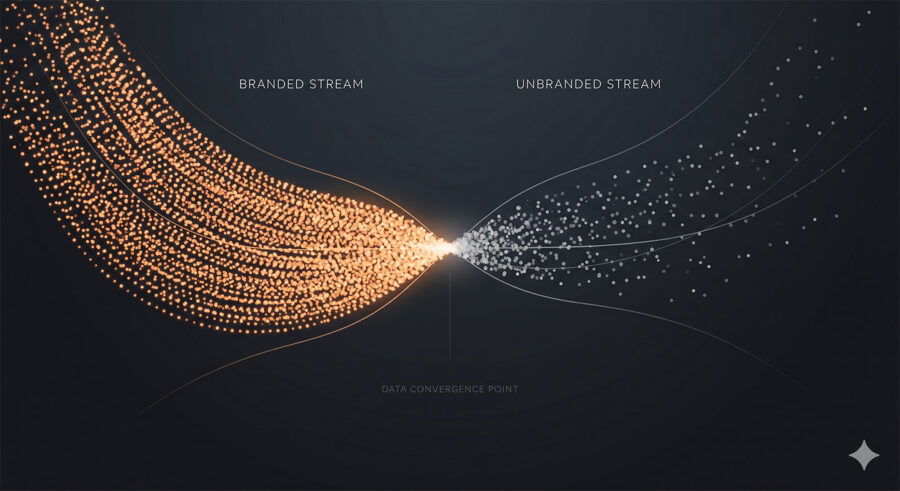
With non-branded search, the discovery layer is getting colder and harder to see. Colder because more of it resolves in an AI answer now, so the people who do click through tend to arrive less committed than they used to. Harder to see because Search Console withholds a growing share of query data for privacy, which means much of your long-tail non-branded performance is anonymized out of your own reports. You’re working partly blind.
Brand search runs the other way. It’s high-intent, qualified, and far likelier to convert, because someone searching your name has already decided to consider you. It’s also trackable in a way non-branded increasingly isn’t. You can watch brand search volume over time, and Search Console’s branded-queries filter now lets you split branded from non-branded directly.
AI raises the stakes on both. When an AI answer cites you, it pulls your reputation, reviews, and coverage from wherever they live, including the page-two results that used to stay buried, and puts them on the first screen of the response. Your reputation across the open web is a first-screen asset now, whether you’re managing it or not.
You’re not the only one landing here. At Google Marketing Live a few weeks after I/O, Google introduced two measurement signals of its own: Attributed Branded Searches, which credits marketing for the brand search demand it creates, and Qualified Future Conversions, which ties early signals like branded searches and video views to conversions up to six months out. Those are ad-side tools, but the direction is the same one we’ve been arguing, that brand demand and downstream conversions matter more than the immediate click.
The leadership move is to treat the brand-to-non-branded ratio as a core metric, not a footnote. A rising brand share is a sign your off-site presence and reputation work are turning into qualified, ready-to-convert demand. A flat brand share while you keep pouring budget into non-branded means you’re buying colder and colder traffic. Track the mix, and invest to grow the qualified side.
Where marketers should focus as search continues to evolve
If you own the budget and the quality bar, five moves fall out of all this:
- Change the scoreboard. Traffic is and has been a micro metric, conversions are the macro one, so grade organic on what it converts. Track your brand-to-non-branded ratio as a leading indicator of qualified demand, and add AI visibility (impressions in the new Search Console report) as a tracked line, with the honest caveat that click attribution isn’t there yet.
- Fund agent-readiness as a build, not a tactic. Put accessibility, speed, crawlability, and clean structure on the developer roadmap, and treat engine-specific tactics like schema or llms.txt as per-platform tests, not universal must-haves.
- Optimize for search everywhere. Treat YouTube, social, and SEO as one discovery system, and brief content to show up as text, video, and credible mentions across the platforms your audience actually uses.
- Keep betting on SEO where it still wins. Branded search, local, and high-intent transactional queries still reward classic SEO, and Cyrus Shepard’s recent analysis of who’s still winning in Google lands squarely in those categories. Don’t abandon the fundamentals because the headlines are loud.
- Invest in credibility. Named authorship, external expert partnerships, and digital PR are the moat while everyone else automates content.
If you want a sharper version of these as questions to put to your own team, we wrote those up in the questions every marketing leader should be asking about AI search.
The bottom line
The I/O 2026 announcements aren’t a checklist to react to one at a time. Together they point one direction: search is becoming an AI-mediated layer between your brand and your customer, on Google and well beyond it. Organic search is decoupling from the website, and discovery, qualification, and the transaction are all moving to surfaces you influence but don’t own.
That’s a threat if you still measure success in sessions. It’s an opening if you measure it in outcomes. The brands that pull ahead this year won’t be the ones chasing every AI tactic or panicking over a traffic dip. They’ll be the ones who change the scoreboard to conversions, build for both people and agents, show up everywhere their audience searches, and invest in the human credibility AI can’t manufacture. None of that is exotic. It’s deliberate, and most of your competitors aren’t being deliberate yet.
That’s the window, and it won’t stay open long. Build for who’s actually knocking, human or agent, on whatever surface they show up.
If you want to pressure-test what this means for your goals, your market, and your numbers, that’s the work our SEO team does every day.